In this article
Regular bread and bread advertised as keto must be evaluated by composition and portion. The terms whole grain, gluten-free, sugar-free, and low carb are not synonyms and do not, by themselves, tell you how much carbohydrate you will consume.
They also do not determine whether the bread is suitable for your plan. The label helps you know the product; individual decision depends on the complete diet.
Read ingredients and table together
A gluten-free bread may use rice, cassava, or tapioca starches. A blend advertised as low carb may also include components you did not expect. Check the formulation instead of concluding that the absence of wheat means absence of carbohydrates.
Compare values on the same basis, such as per 100 g, then consider the weight of the slice consumed. The package portion may correspond to more than one slice.
- Check the full ingredient list.
- Observe how many slices make up the stated portion.
- Use the actual weight when it differs from the manufacturer’s measure.
- Include filling, sauce, and accompaniments in the meal.
A fictional example of slices
Imagine a product with 6 g of carbohydrates in 50 g of bread. A 25 g slice would have 3 g; two such slices would total 6 g. The values are fictional and do not represent a bread sold on the market.
The example does not indicate a recommended amount. It shows why counting slices without considering weight can produce different results between products.
Fiber and net carbohydrates
On labels in Brazil and the European Union, carbohydrates exclude fiber. Do not subtract fiber again. In the United States, Total Carbohydrate includes fiber, so it is necessary to identify the labeling system before comparing.
Polyols and other blends should not be fully deducted by a universal rule. A net carbohydrate number highlighted by the manufacturer does not eliminate the need to understand composition and the basis of the calculation.
Homemade bread requires the full recipe
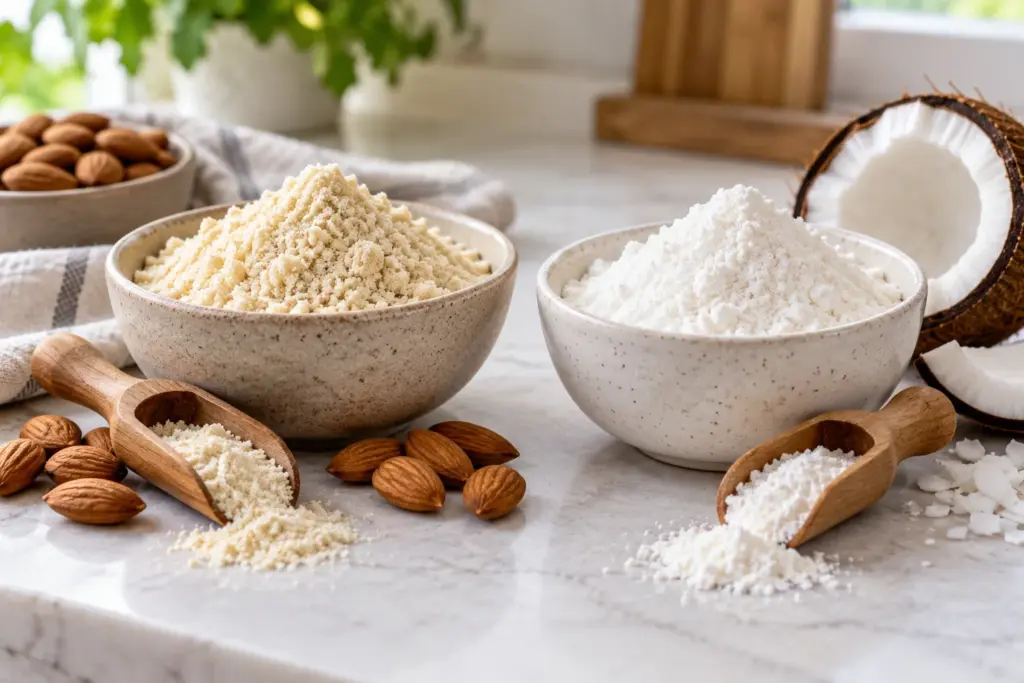
Add up the ingredients and consider the final yield. Almond and coconut flours cannot be automatically substituted by the same weight or volume in any recipe. Texture and other components influence the result.
A homemade recipe does not receive reliable macros simply by using a different flour. Without weights, product composition, and yield, it is not possible to assign a precise value per slice.
Presentation alternatives and allergies
A sheet used to wrap a filling or an omelet may be presentation options. They are not nutritionally equivalent to bread by definition, nor do they represent recipes tested by CetoPlan.
Almond flour, eggs, and milk also require attention for those with allergies. The gluten-free description does not automatically resolve other restrictions or possible contact during preparation.
Avoid treating bread as a food that prevents any weight loss or keto bread as a product that causes weight loss. The name does not guarantee a result; composition, quantity, and dietary context must be considered.
Related readings
- Almond flour or coconut flour: differences and substitutions
- Keto breakfast: options and how to check carbohydrates
- How to calculate carbohydrates per serving in a recipe
- Risks and precautions before starting the ketogenic diet
Sources and limits
Informational content prepared with support from artificial intelligence, without independent clinical review. It does not replace assessment by a doctor or dietitian. Meal examples are not an individual meal plan or tested recipes. The image is illustrative and was generated by AI.
European Union: food information regulation

Mariana is passionate about a healthy lifestyle.